When most parents hear the word “Minecraft,” they think of hours lost to screen time. When a therapist hears it, they might think of something else entirely: an unusually powerful therapeutic tool.
At Atrium Clinic, we have been working with children and young people aged 7 to 21 using digital game-based therapy since 2014. Minecraft has become one of the most effective games in our clinical toolkit — not because it is entertaining, but because of what it allows a child to do emotionally what traditional talking therapy sometimes cannot.
Why Talking Isn’t Always Enough
Many children who struggle emotionally find it hard to talk directly about their feelings. This is not unwillingness — it is developmental. The brain regions responsible for verbal emotional processing are still maturing well into adolescence, and for children who have experienced trauma, anxiety, or neurodivergence, direct conversation about feelings can feel threatening rather than helpful.
Play has always been children’s natural language for processing difficult experiences. Minecraft extends that language into a digital space that already feels safe, familiar, and motivating to most young people.
What Makes Minecraft Therapeutically Useful
Minecraft is a sandbox game — there are no fixed goals, no winners or losers, no failure state. Players explore, build, survive, and create in an open world. This structure gives it several properties that therapists find clinically valuable.
Creative expression without pressure. A child who cannot articulate that they feel unsafe at home may build a fortress with no doors. A child grieving a loss may recreate a place that felt secure. The game becomes a projective space — like a digital sandtray — where inner worlds are externalised safely.
Distance and metaphor. Working through a Minecraft world together allows a therapist and child to explore themes of control, safety, loss, relationships, and identity indirectly. The metaphor reduces threat and opens up conversations that direct questioning would shut down.
Engagement for hard-to-reach young people. Children who have disengaged from school, refused conventional therapy, or been labelled as “difficult to reach” often engage readily in Minecraft-based sessions. The game lowers the barrier to the therapeutic relationship itself.
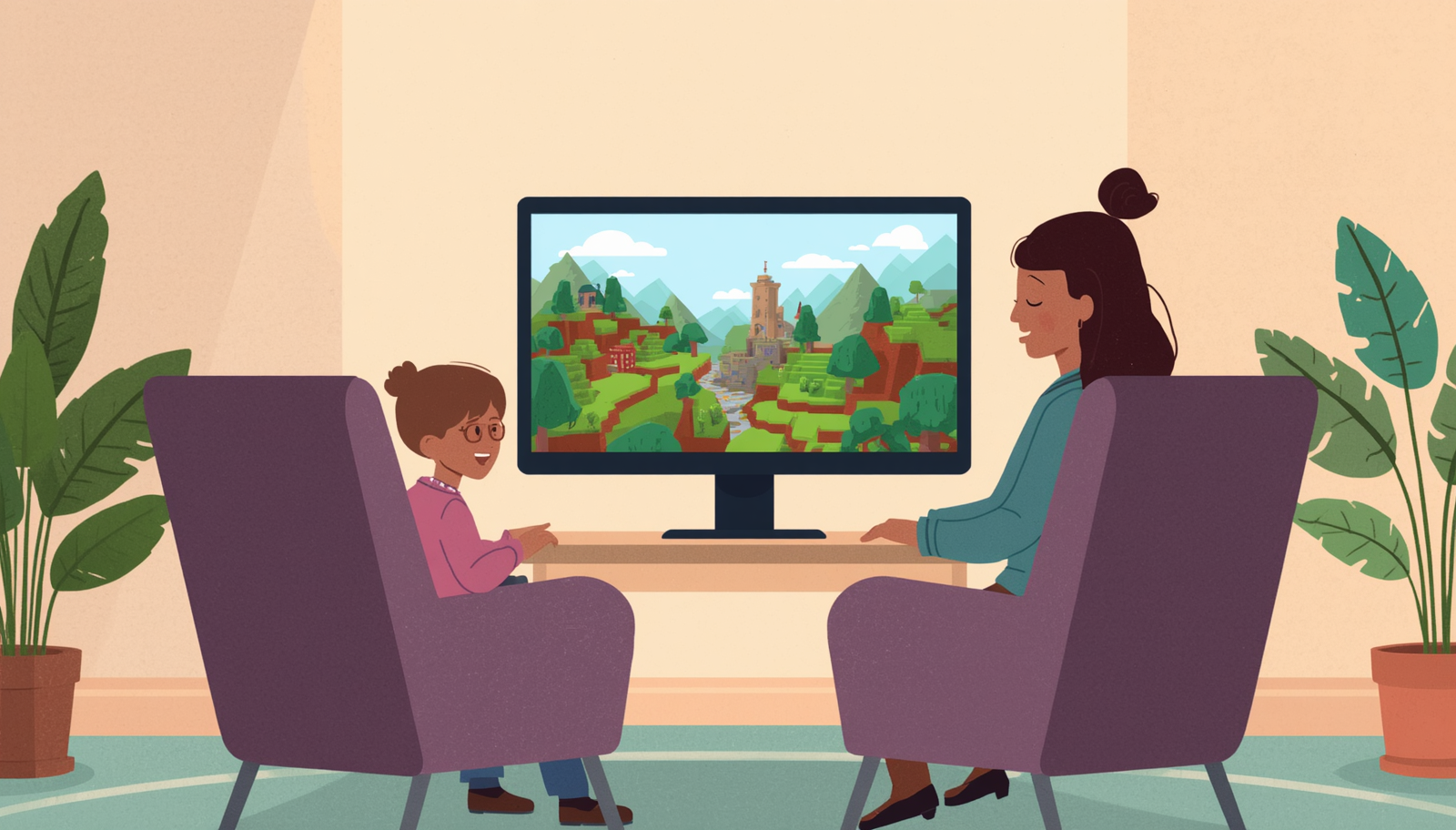
Collaboration and co-regulation. Playing Minecraft together in a session creates shared experience. The therapist is not positioned as an authority figure asking questions, but as a fellow player navigating the same world — a subtle but powerful shift in relational dynamic.
Mastery and self-efficacy. Building something, solving a problem, surviving a challenge — these experiences generate feelings of competence. For young people whose self-esteem has been eroded by school exclusion, social difficulties, or trauma, this matters.
The aim of gaming therapy in this context is to support the young person to learn and experiment in their preferred digital world so they can build the confidence and skills to confront challenges in the real world when applicable.
What the Evidence Shows
Our own service evaluation, conducted in partnership with Anglia Ruskin University, followed more than 60 children and young people through a structured game-based therapy programme. Over 90% showed measurable improvement on the YP-CORE (a validated measure of young people’s psychological wellbeing) and the SDQ (Strengths and Difficulties Questionnaire, completed by parents and teachers).
Improvements were particularly notable among boys — a group significantly less likely to engage with traditional talking therapies. This matters given the well-documented gap in boys’ mental health help-seeking.
These findings align with a broader literature on game-based and play-based therapies, including work from Rice (2022), Stone (2019, 2022), and Kowert & Quandt (2020), all of which explore how digital play can support therapeutic outcomes across a range of presentations.
How It Works in Practice: Our Approach
Minecraft sessions at Atrium Clinic are not unstructured play. They follow a structured clinical protocol — now available as a Routledge pocket book — developed and refined over years of practice. Each session is delivered by a BACP- or HCPC-registered therapist trained in the protocol. The therapy programme holds the young person and their family at the heart of the approach with parents and carers being supported to continue play outside and beyond the therapy intervention, strengthening family bonds in the process.
A typical session might involve:
- Check-in — the young person and therapist reconnect at the start, sometimes using in-game activity as a bridge
- Collaborative or solo play — the therapist follows the child’s lead, observing themes, narratives, and emotional tone in what is being built or explored
- Reflection — drawing out meaning from the game world, making links to real experience where the child is ready
- Check-out — closing the session safely, with attention to regulation if anything difficult has emerged
Sessions are time-limited, goal-focused, and reviewed against outcome measures throughout.
Who Benefits Most
In our experience, Minecraft-based therapy is particularly well suited to:
- Children aged 7–14 who find direct conversation about emotions difficult
- Young people with anxiety, trauma histories, or attachment difficulties
- Neurodivergent young people, including those with ADHD or autism, who may find the structure and predictability of the game regulating
- Boys and young men who have disengaged from conventional support
- Children who have been excluded from school or are reluctant to engage with adults in professional roles
It is not a replacement for all therapeutic approaches — it works best as part of a broader therapeutic plan, alongside relational therapy, trauma-informed practice, or CBT where indicated.
For Schools and Families
If you are a teacher or school pastoral worker wondering whether game-based therapy might help a young person you support, the short answer is: it is worth exploring. The approach requires a trained therapist, a clear referral pathway, and parental consent — but it does not require specialist equipment beyond a computer and a copy of Minecraft.
If you are a parent of a child who loves Minecraft and struggles emotionally, you may find that their engagement with the game already tells you something. What they build, who they play with, and how they respond to in-game challenges can all be windows into their inner world.
We offer a free guide for school staff on gaming and young people’s wellbeing, available to download from our Free Resources page.
For Therapists: Getting Trained
Atrium Clinic offers CPD-accredited training for therapists, counsellors, and other professionals who want to integrate gaming into their therapeutic practice. Our courses cover the clinical rationale, the protocol, safeguarding considerations, and practical skills for working with Minecraft and other digital platforms in sessions.
Group training sessions and individual 1-to-1 training are available. Details on our Courses page.
A Final Word
The children who benefit most from Minecraft-based therapy are often the ones the system has struggled most to reach — those who have rejected or been failed by conventional support. The game does not do the therapeutic work. The therapist does. But Minecraft creates conditions in which that work becomes possible.
If you would like to know more about game-based therapy, explore our Evidence page or get in touch with the Atrium Clinic team.
Dr Sara Ireland and Monique Beckett lead Atrium Clinic’s gaming therapies work. Their forthcoming Routledge pocket book, Video Gaming Therapies: A Guide for Practitioners Working with Young People, will be published in 2026.